
Garris Lab
Read BioOur group aims to understand the roles dendritic cells (DCs) play in the development and response to treatment of cancer.
DCs are a key bridge between innate and adaptive immunity, and are essential for cancer immunotherapy. These cells can also serve as a direct immunotherapy target, with several dendritic cell targeting agents in clinical trials. Chief among these are CD40 agonistic antibodies, which have shown great promise as a cancer treatment by virtue of their ability to turn immunologically "cold" tumors "hot".
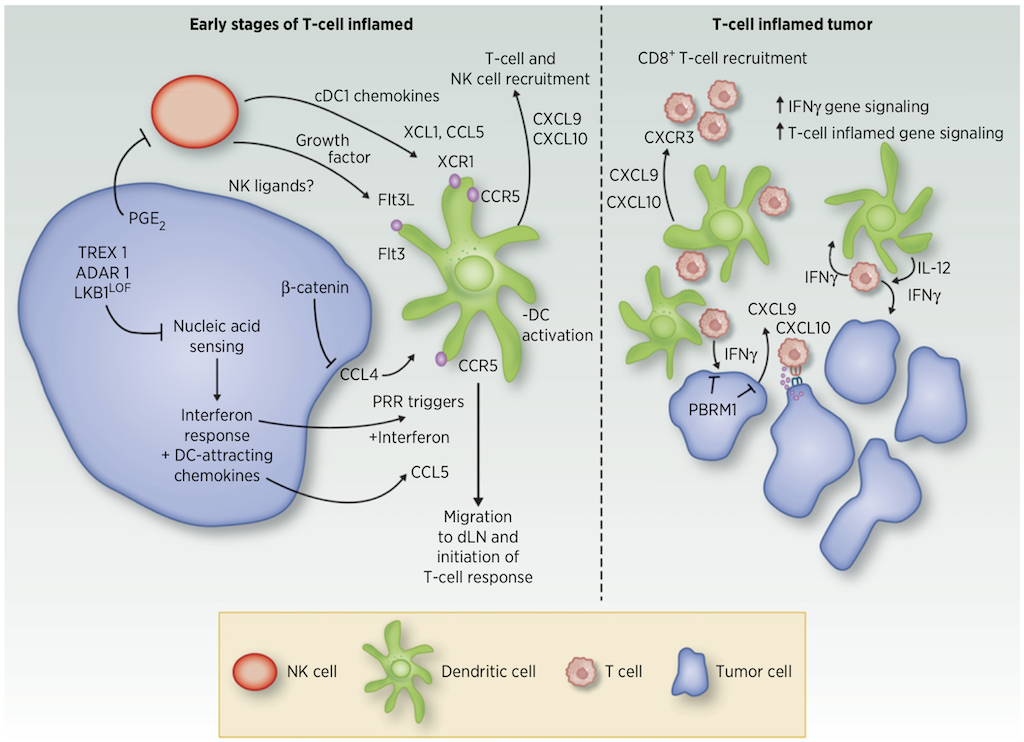
Immunologically “hot” or T cell inflamed tumors are associated with enhanced response to cancer immunotherapy through immune checkpoint blockade, and tumor T-cell inflammation is positively associated with tumor DC infiltration. Tumor features that promote or inhibit DC functions remain incompletely understood and we hypothesize that understanding these features can lead to new immunotherapy strategies to treat cancer.
We are developing mouse models to mechanistically dissect dendritic cell functions in cancer and inflammation as we believe that tumor-dendritic cell interactions are a critical determinant of tumor immunogenicity, and that dendritic cell functions are essential for durable cancer immunotherapy response.
Recent Publications
Nguyen YTM, Pfefferlé M, Oh J, Simpson GG, Walker SA, Noguchi S, Garris CS, Deutsch-Williams RJ, Wirapati P, De Stefano F, Goemans M, Dai R, Vinegoni C, Fernández Del Castillo C, Liss AS, Pittet MJ, Weissleder R
Driving tumor-associated macrophages to a CXCL9Hi/SPP1Low phenotype eliminates pancreatic cancer. Cell Rep Med. 2026;7(8):102938 - PMID: 42492520 - PMCID: PMC13522754 - DOI: 10.1016/j.xcrm.2026.102938Gupta A, Das R, Reed K, Jeon T, Nguyen QTC, Rudra A, Ge X, Trongjit S, Vanrobaeys YS, Langer R, Weissleder R, Garris C, Anderson DG
Immune-remodeling mRNAs expressing IRF8 or NIK generate durable antitumor immunity in multiple cancer models. Nat Biotechnol. 2026;:ePub - PMID: 42129506 - PMCID: PMC13242704 - DOI: 10.1038/s41587-026-03115-2Kim HS, Oh J, Jeon J, Fei F, Parvanian S, Kohler R, Garris C, Weissleder R
A ribonucleotide carbohydrate system (iRNC) enhances antigen presentation and controls glioblastoma. Theranostics. 2026;16(8):3912-3927 - PMID: 41695470 - PMCID: PMC12905671 - DOI: 10.7150/thno.127558Zitti B, Duval F, Wirapati P, Hicham M, Xie Y, Oh J, Hoelzl J, Meiser P, Varrone M, Peterson HM, Cianciaruso C, Bill R, Bayerl F, Bolli E, Goubet AG, Kiss M, McDowell S, Cheng P, Celestini D, Terzic J, Zwahlen T, Alouche N, Zouggari N, Tarussio D, Tissot S, Nunes-Hasler P, Mino-Kenudson M, Lanuti M, Faquin WC, Sadow PM, Tille JC, Intidhar Labidi-Galy S, Garris CS, Hugues S, Petrova TV, Ludewig B, Quezada S, Luther S, Mempel TR, Ciriello G, Pai SI, Michielin O, Böttcher JP, Weissleder R, Pittet MJ
Positioning and reversible suppression of CCR7+ dendritic cells in perivascular tumor niches shape cancer immunity. Immunity. 2025;59(1):161-176.e12 - PMID: 41421339 - PMCID: PMC12882814 - DOI: 10.1016/j.immuni.2025.11.020Garris C, Dunn GP, Weissleder R
Targeting myeloid cell polarization to prevent GBM recurrence. Mol Ther. 2025;34(1):41-43 - PMID: 41421347 - PMCID: PMC12925746 - DOI: 10.1016/j.ymthe.2025.12.019- More publications ...
News
We're excited to share that the Mass General Brigham Research Spotlight features CSB (Weissleder Lab and Garris Lab) paper published in Nature Biotechnology, “Immune-remodeling mRNAs expressing IRF8 or NIK generate durable antitumor immunity in multiple cancer models." (PDF)